What are the latest AI search stats and what do they mean for B2B marketers?
AI search and chatbots have changed how B2B buyers discover products, evaluate vendors, and validate purchase decisions.
More than just changing their search habits, AI tools are becoming research assistants and trusted advisors for modern technology buying teams, playing an increasingly prominent role throughout the buying journey. And marketing teams are responding.
Budgets are being allocated. Strategies are becoming more formalized. AI visibility is finding its way onto executive agendas. But measurement remains messy, attribution is far from complete, and third-party validation strategies remain in their infancy.
To understand where the market stands, we’ve rounded up the latest findings from TechnologyAdvice, G2, Similarweb, AirOps, 6sense, SEOFOMO, and other AI visibility research. Together, the findings paint a clearer picture of where AI is showing up in the B2B buying journey, how marketing teams are responding, and where some of the biggest gaps remain.
Here’s what B2B marketers need to know.
AI search is influencing the entire B2B buying journey
Many marketing teams still treat AI search as a top-of-funnel discovery channel. The data tells a different story.
TechnologyAdvice recently analyzed more than 60 million instances during the first six months of 2026 in which AI search engines cited content across 30 major TechnologyAdvice-owned B2B technology media and review sites. The results showed the following:
- 63.8% of those instances were associated with top-of-funnel queries, including questions about markets, problems, trends, and important capabilities.
- The remaining 36.2% were associated with middle- and bottom-of-funnel queries. These included product recommendations, vendor comparisons, questions about specific companies, and questions about specific solutions.
- In a similar study of citations from across TechnologyAdvice’s consumer-oriented media sites, more than 95% of those citations were related to top-of-funnel consumer technology queries, while less than 5% were a result of a bottom-of-funnel query.
This citation data suggests that AI’s role in the B2B buying journey extends beyond explaining a category. AI answers are also appearing in response to queries for product recommendations, vendor comparisons, and details about specific companies and solutions.
For marketers, the objective is now much broader than appearing in an educational answer or driving more website traffic.
Brands need to be visible during discovery, recommended during evaluation, accurately represented during validation, and trusted when buying groups make a decision.
Source: TechnologyAdvice analysis of AI search across the B2B buying journey, 2026
B2B buyers are already using AI to research and choose software
TechnologyAdvice’s citation data shows where AI answers are appearing across the funnel. Buyer research from G2 and 6sense helps show how widespread and influential that behavior has become.
G2 surveyed more than 1,000 B2B software buyers and decision-makers for its 2026 AI Search Insight Report. It found:
- 71% rely on AI chatbots somewhere in the software research process.
- 54% named generative AI chatbots as a source influencing which vendors make their shortlist, ahead of research firms, vendor websites, peers, and salespeople.
- 69% said an AI chatbot led them to choose a different software vendor than initially planned.
- 51% said they now start their software research with an AI chatbot more often than Google.
But buyers still want proof. G2 found that 45% said a review-site citation was the most confidence-inspiring signal in an AI answer
Separate research from 6sense’s Buyer Experience Report found that 94% of B2B buyers used large language models during their most recent buying process. Yet buyers still averaged 16 additional interactions with the winning vendor, essentially unchanged from prior years.
In other words, AI is helping buyers synthesize information, inform their shortlist, and prepare for vendor conversations. It isn’t eliminating the need for validation and human engagement.
Sources: G2’s 2026 AI Search Insight Report; 6sense research on GenAI and B2B buyer research
AI visibility is becoming a leadership and budget priority
Aleyda Solis’ SEOFOMO State of AI Search Optimization Report, 2026 surveyed 171 search professionals across 36 countries between August 17 and 27, 2026.
With a baseline set in the prior year, the survey gathered feedback on how search agencies and in-house search specialists see AI visibility strategies and investments evolving. And the year-over-year shifts are hard to ignore:
- 98% of respondents had been asked by a client, manager, or decision-maker about AI search visibility, up from 91% in the previous survey.
- 69% said a budget had been allocated to AI search optimization, compared with 38% in 2025.
- 61% said investment increased during 2026, while only 1% reported that it decreased.
- 75% had a dedicated AI search optimization strategy for at least some of the sites they worked with, up from 51%.
- 57% had a dedicated strategy for all or most of their sites.
- 92% monitored AI visibility and citations for at least some sites, up from 78%.
- The share saying nobody owned AI search optimization fell from 11% to 4%.
The takeaway? AI visibility is becoming a funded, monitored, and increasingly accountable marketing priority.
It’s moving from an experiment to an expectation.
Source: SEOFOMO State of AI Search Optimization Report, 2026 Edition
SEO owns much of the work, but it can’t succeed alone
AI search optimization is still largely landing with SEO teams.
- 77% of SEOFOMO respondents said the SEO team or SEO specialists had primary responsibility for AI search optimization.
- Only 4% reported having a dedicated AI search optimization specialist or team.
That makes sense. Technical accessibility and content structure help AI systems find and use information.
But there’s a much bigger information ecosystem at work. Positioning, research, reviews, digital PR, publisher coverage, and communities can all shape what AI systems encounter when generating answers.
This isn’t just an SEO challenge: a sentiment that was captured in following quote from an SEOFOMO survey respondent:
“77% isn’t necessarily a sign that SEO has won. It might be a sign that the organisation has lost. The danger is that we build another permanent function around the symptoms: more specialists, tools, dashboards, content, optimisation. Lots of activity, while the actual reasons a brand isn’t being surfaced remain untouched. Sometimes the fix is technical – but more often it’s better messaging, stronger evidence, clearer differentiation, better products, better market fit, or simply being worth talking about. The goal shouldn’t be to turn SEO teams into AI optimisation teams. It should be to make both teams unnecessary.”
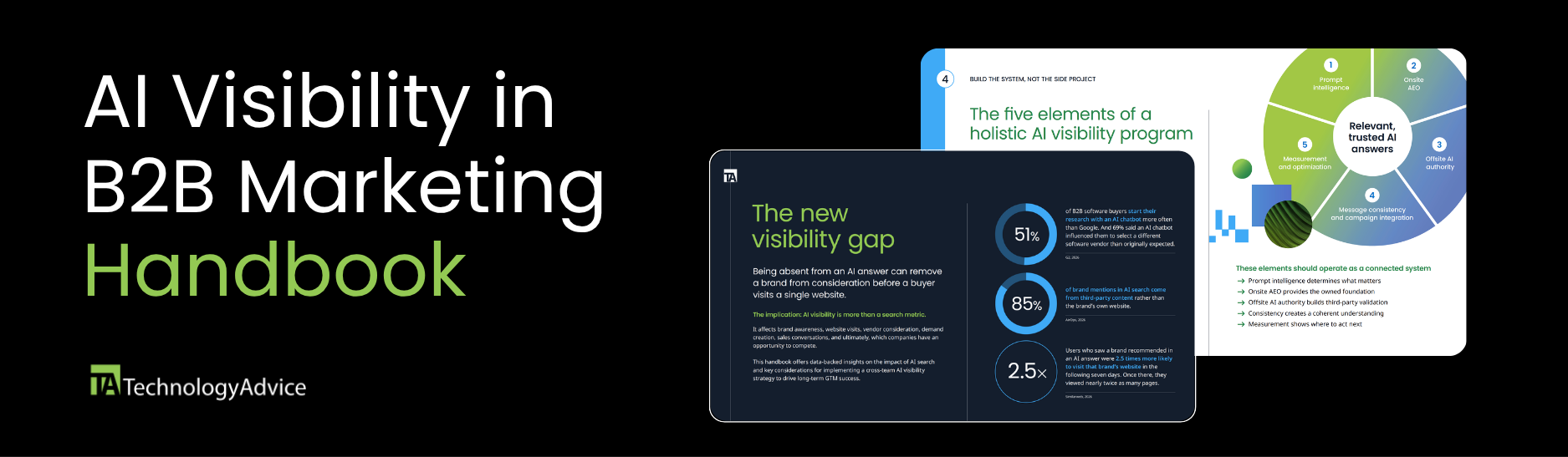
TechnologyAdvice’s AI Visibility Handbook for B2B Marketing Teams recommends a cross-team approach to AI visibility with critical roles being played by brand, content marketing, PR, demand gen, and product marketing – in addition to digital marketing and SEO.
Source: SEOFOMO
Measurement and attribution remain major obstacles
More teams are tracking AI visibility. Proving its full value is another story.
When SEOFOMO asked respondents to select their three biggest challenges:
- Reliably measuring AI search visibility was the most frequently selected challenge, chosen by 94 of 171 respondents.
- 69 respondents selected understanding what actually influences AI visibility.
- Another 69 selected connecting AI visibility with traffic, conversions, and revenue.
- 59 identified a lack of reliable data.
- 35 selected rapid changes across AI platforms and models.
- 33 selected identifying the right prompts and queries to optimize.
Revenue reporting highlights the same attribution gap:
- 46% attributed only 0% to 5% of site revenue to AI search.
- 35% said they had no idea how much revenue AI search contributed.
- The share attributing more than 5% of revenue to AI search increased from 8% to 19% year over year.
There are some early signs of positive impact, but the results are far from universal. 56% of SEOFOMO respondents reported at least some positive business impact, but only 5% called it significant, while 28% reported no measurable impact yet.
And direct attribution may not tell the whole story.
Similarweb’s analysis of thousands of user journeys illustrates why AI’s broader influence can be difficult to capture:
- Users who received an AI recommendation were 2.5 times more likely to visit the recommended brand’s website within the next seven days.
- AI-influenced visitors viewed nearly 2x as many pages and spent about twice as long on the site as standard visitors, making them higher value.
- However, 56% of those AI-influenced visits arrived through branded search rather than as a direct referral from an AI answer citation.
A buyer might discover a brand in an AI answer, search for it by name, visit a review page, or return later. Analytics could credit another channel even if AI played a role earlier in the journey.
For B2B marketers, that means it’s worth examining AI-referred traffic alongside branded search, direct traffic, related traffic referral sources, signups or demo requests, and inbound pipeline. Some connections will be measurable while others may show up as informed correlations rather than direct attribution.
Sources: SEOFOMO; Similarweb study on the downstream impact of AI recommendations
Content and technical fundamentals are producing the most impact
So, what’s actually helping to generate brand mentions and recommendations in AI answers?
SEOFOMO asked respondents to choose the three activities that had delivered the most meaningful positive impact on AI search visibility.
The leading responses weren’t shortcuts or shiny new tricks. They were strong content and technical fundamentals:
- 80 respondents selected expanding content to cover relevant questions, topics, and intent.
- 75 selected improving technical crawlability and accessibility for AI platforms.
- 69 selected restructuring content to make answers and information easier to retrieve.
- 45 selected strengthening brand and entity signals.
- 38 selected earning third-party mentions, citations, or coverage.
- 26 selected creating original research, data, or expert-led content.
The message is practical: make useful information easier to find, retrieve, understand, and trust.
For B2B marketers, that means mapping buyer questions, filling content gaps, clarifying product information, and investing in an off-site content strategy that creates credible third-party signals.
Source: SEOFOMO
Owned content matters, but so does third-party validation
One of the more interesting findings from recent data is the gap between onsite AEO activity and broader off-site authority building.
Brands are investing in what they publish. Fewer are investing in which third-parties validate their message and recommend their products.
In SEOFOMO’s survey, only 51 respondents said they were currently earning third-party brand mentions, citations, or coverage through digital PR or publisher-direct partnerships. Just 27 were working to improve reviews and reputation across third-party platforms.
Yet digital PR and third-party validation were among the five most frequently selected activities delivering meaningful positive impact. That disconnect creates an opportunity.
Other research has found a similar off-site pattern at a much larger scale, validating its importance as part of an AI visibility strategy:
- AirOps’ research found that 85% of brand mentions in AI answers came from third-party content citations, rather than the brand’s own website.
- Similarweb’s latest research revealed similar findings, while also noting that 55% of brand mentions in ChatGPT were sourced specifically from third-party news and review sites.
AirOps’ research also points to the importance of keeping owned content current.
- Across roughly 15 million AI-answer data points, 70% of AI-cited pages had been updated within the previous year.
Much like real buyers, AI answers don’t rely exclusively on what brands say about themselves and they value timeliness and recency.
While owned content and onsite AEO express your positioning and expertise, third-party publishers, reviews, research, experts, customers, and communities validate those claims and offer critical signals that AI platforms rely on.
Sources: SEOFOMO; AirOps AI Search Playbook for Marketers; Similarweb 2026 Generative AI Landscape Report
What these AI visibility statistics mean for B2B marketers
AI search isn’t just an emerging discovery channel. It’s influencing how B2B buyers learn, compare, validate, and decide, while marketing teams rapidly build budgets and strategies around it.
The combined research points to five key priorities for B2B marketing teams:
- Map buyer questions across the journey. Identify the prompts buyers may use during category education, product discovery, vendor comparison, and final validation.
- Monitor the answers, not only the citations. Evaluate whether your brand appears, how it’s positioned, which competitors are recommended, and whether the information is accurate.
- Strengthen owned content and AEO. Make priority information accessible, well structured, evidence-backed, and aligned with real buyer questions.
- Build third-party validation. Invest in independent media, reviews, expert perspectives, original research, customer evidence, and relevant communities via PR and publisher-direct partnerships.
- Measure influence broadly and honestly. Track mentions, citations, sentiment, share of voice, traffic, branded demand, engagement, and pipeline while distinguishing direct measurement from inferred impact.
The brands that adapt won’t simply have a better chance of earning AI citations.
They’ll be better positioned to appear when buyers discover, compare, validate, and shortlist potential vendors – helping them build brand awareness, earn buyer trust, and create more efficient product demand.
Build your AI visibility strategy
Ready to dive deeper?
The AI Visibility Handbook for B2B Marketing Teams explores how AI is changing discovery, evaluation, and decision-making, and what it means for your digital, demand generation, brand, content, PR, and product marketing teams. Use it to start mapping priority prompts, assessing how your brand appears, and connecting owned content and AEO with credible third-party validation.
Get the AI Visibility Handbook →