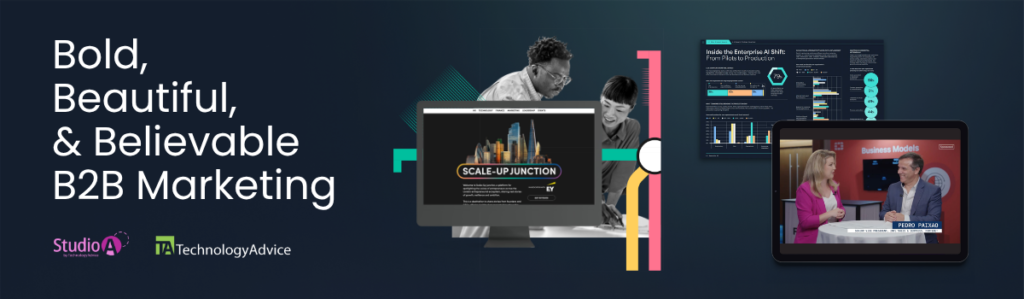
There’s never been more B2B content competing for buyers’ attention.
Every day, another report lands in an inbox. Another webinar promises a fresh perspective. Another article, video, podcast, or social post enters the feed. And with generative AI making it faster than ever to produce more, the volume will only keep growing.
For content marketers and demand gen teams, that creates an uncomfortable reality: publishing is easier, but being remembered is harder.
The answer isn’t simply to produce more content. It’s to create something worth noticing, believing, using, and sharing. Something bold enough to interrupt the scroll, beautiful enough to invite people in, and believable enough to earn trust.
That’s the opportunity for B2B brands. When creativity and credibility work together, content becomes more than another asset on the calendar. It becomes an experience that can shape a buyer’s thinking, strengthen brand preference, and give an entire buying group something meaningful to discuss – putting your brand at the center of their next conversation.
So, what makes B2B content genuinely compelling?
Our results from running hundreds of content campaigns for B2B tech brands have shown that four qualities consistently matter: it earns attention, builds trust, delivers timely value, and inspires people to pass it on.
Let’s hop into what these really mean and how to not sacrifice one for the other. Then we’ll dive into six real-world examples of recent B2B content campaigns that knocked all four of these out of the park, as a bit of inspiration for your next planning session.
It earns attention for the right reason
Before content can educate, persuade, or convert, it has to be noticed.
That doesn’t mean every campaign needs a cinematic budget, an elaborate interactive build, or a clever visual gimmick. Bold content isn’t defined by how loudly it announces itself. It’s defined by how quickly it gives the right audience a reason to care.
Sometimes that reason is an unexpected creative concept. Sometimes it’s a sharp point of view that challenges familiar thinking. It might be a product story people can see rather than read, a data experience they can explore, or a complicated idea made refreshingly simple.
The format matters because it shapes the first interaction. But format can’t rescue a weak idea. A beautiful campaign that makes people work to understand its purpose may win a glance without earning another moment of attention.
The strongest concepts create immediate clarity and curiosity. They help the audience answer three questions almost instinctively:
- Is this for me?
- Why does it matter now?
- What will I gain by continuing?
That’s the difference between decoration and creative strategy. Decoration makes an asset look polished. Creative strategy makes the idea easier to enter, experience, and remember.
Consider the story before selecting the format. A visually complex product may come alive through a concise demonstration. An emerging market shift may be more compelling when proprietary data is paired with expert reaction. A practical challenge may be better served by an interactive tool than another linear PDF.
The goal isn’t to be different at any cost. It’s to make the value unmistakable and make the audience want to take the next step.
It gives buyers a reason to believe
Attention opens the door. Trust determines whether buyers walk through it.
B2B audiences know when they’re being sold to. They recognize unsupported claims, conveniently perfect customer stories, and content that treats the brand as the answer to every question. The more polished the message, the more important it becomes to prove there’s substance behind it.
Believable content shows its work.
It may draw on original research, practitioner expertise, customer experience, product evidence, or informed editorial perspectives. Whatever the source, the proof should advance the audience’s understanding, not sit on the page as a decorative credibility signal.
A statistic should clarify the size or urgency of a problem. An expert quote should introduce experience or nuance the brand can’t provide alone. A customer story should reveal enough about the process, challenge, and outcome to feel real. A demonstration should let the audience see a capability in action rather than asking them to accept a claim.
Credibility also requires restraint. Believable content acknowledges complexity. It avoids pretending every approach works for every team, and it doesn’t hide the practical considerations buyers will eventually encounter.
For brands, that can mean giving up a little control to create something more trusted. Independent research, credible contributors, publisher partnerships, and community voices can bring authority and perspective to a story. The brand doesn’t always need to be the loudest voice in the room. Sometimes its most valuable role is to bring the right voices together.
In a landscape filling quickly with competent but interchangeable AI-generated content, authentic expertise becomes even more valuable. Buyers don’t need another smooth summary of what’s already known. They need evidence, experience, and a point of view they can use.
It connects with something buyers value
Compelling content begins with the audience’s reality, not the brand’s publishing plan.
When a project starts with “What do we want to say?” the result often feels like marketing. When it starts with “What does our audience need to understand, solve, or decide?” it has a much better chance of becoming useful.
Relevance is about timing and context. Value is about what the audience can do with the experience afterward.
Before developing the concept, get specific:
- Who is this really for?
- What are they navigating right now?
- What do they already know?
- What’s missing from the existing conversation?
- What should become clearer, easier, or more actionable after they engage?
Those answers should shape the angle, depth, format, and distribution plan.
A senior executive may need a concise view of market implications. A practitioner may want a detailed workflow, an honest demonstration, or a framework they can apply immediately. A buying committee may need several entry points into the same idea because technical, financial, and operational stakeholders will evaluate it differently.
More content isn’t automatically more valuable. Neither is longer content. A two-minute video can do more than an hour-long webinar when it makes an unfamiliar product tangible. A focused research finding can be more useful than a dense report when it gives a team the evidence needed to act. An interactive hub can outperform a linear guide when each stakeholder can find the information that matters to them.
The better question isn’t, “How much can we include?” It’s, “What’s the most useful experience we can create?”
LOOKING FOR REAL-WORLD INSPIRATION? Explore six Bold, Beautiful, and Believable B2B content campaigns that turned strong ideas into memorable content experiences.
It gives people something worth sharing
The best B2B content rarely ends with the first reader.
It gets saved for planning season, referenced in a meeting, shared in Slack, forwarded to a colleague, or used to help another stakeholder understand why a decision matters. Its influence grows because the original audience chooses to carry it into another conversation.
That makes shareability more than a distribution outcome. It’s a signal of trust and utility. When someone shares an asset, they attach a small piece of their professional reputation to it.
People pass along content that helps them do something: explain a difficult idea, support a recommendation, challenge an assumption, align a team, or make a decision with greater confidence.
Shareworthy content often includes:
- A central idea that’s easy to summarize and hard to forget
- Original data or credible evidence people can reference
- A useful framework that gives a team common language
- Concrete examples that make an abstract issue tangible
- Distinct perspectives that invite discussion
- Visual takeaways that can stand on their own
Design plays an important role here. A strong visual system can help people navigate, recall, and reuse the ideas. But beauty has to serve meaning. A polished asset with nothing new to say may earn an initial click, but it’s unlikely to become part of a buying-group conversation.
Bold, beautiful, and believable work together
None of these qualities can do the full job alone.
Bold content without credibility may generate impressions without influence. Trustworthy content without an engaging entry point may never reach the people it could help. Timely content without meaningful takeaways adds to the noise. Valuable content that’s difficult to reference or share limits its own impact.
The strongest B2B campaigns bring all four qualities together. They earn attention, reward curiosity, build confidence, and travel farther than the original placement.
Before launching your next campaign, ask:
- Attention: Is the idea or execution distinctive enough to earn a closer look?
- Trust: Are the claims supported by expertise, research, evidence, experience, or trusted industry voices?
- Value: Does the content help this audience understand, decide, or do something that matters now?
- Sharing: Have we created something people will want to save, discuss, or send to someone else?
If one answer is weak, adding more is rarely the solution. Sharpen the point of view. Replace a generic claim with proof. Invite a credible voice into the story. Choose a format that makes the idea easier to experience. Remove anything that distracts from the value.
Because the real measure of B2B content isn’t whether it was published on schedule. It’s whether it was worth the audience’s time and whether it gave them a reason to remember the brand behind it.
See these principles in action: six examples
Understanding what makes compelling B2B content is one thing. Seeing those principles applied in the real world is another. Those six campaigns we mentioned earlier show just how different the execution can look.
In the Bold, Beautiful, and Believable B2B Marketing guide, we break down six standout content-led B2B campaigns and explore what made each one work. The examples span different formats, audiences, and industries, but they share the same core strengths: strong creative execution, credible expertise, real audience value, and experiences people actually want to engage with.
If you’re looking for ideas you can bring into your own planning, this guide offers practical inspiration from campaigns built around interactive experiences, short-form video, publisher-led research, collaborative content hubs, event-driven storytelling, and visual thought leadership.
And hopefully you find the guide itself to be bold, beautiful, and believable. Who doesn’t love some meta marketing materials?!