Generative AI search engines have forever changed how business professionals learn, research, and evaluate potential vendors.
And the shift is only accelerating.
Instead of running a Google search, opening a list of links, comparing competing claims, and building a shortlist from scratch, buyers are now asking AI to do much of that analysis for them. It can explain a category, recommend products, compare vendors, and help determine what deserves further consideration.
And it can do all of that based on the latest market insights, independent product reviews, customer feedback, and expert opinions from across the digital landscape.
This shift changes more than just the search experience itself. It changes how brand trust is formed, products are perceived, and vendor shortlists take shape.
And while many marketers still think of AI search as an awareness and inbound traffic channel, new research from TechnologyAdvice suggests its influence extends much further into the B2B buying journey, impacting everything from brand awareness and preference to demand creation, lead generation, and customer acquisition.
How are B2B buyers using AI search and chatbots?
Once upon a time (roughly one year ago), a buyer researching a technology category had to assemble the story for themselves. They might enter some keywords into a search engine, open several results, visit vendor websites, compare reviews, read multiple analyst reports, and source validation from their peers over the course of several hours, days, or even weeks.
AI answer engines are compressing much of that work, helping buyers discover, synthesize, and interpret vast amounts of information in a matter of moments.
And they’re doing so in support of each stage of the B2B buying journey.
An early-stage buyer might ask what capabilities matter in a hybrid-mesh firewall or which payroll tools support distributed teams with complex tax requirements. Later, the prompts become more specific: Which CRM platforms suit a large manufacturing sales organization? Which data governance vendors support healthcare teams with HIPAA requirements? How do two shortlisted products compare and which is best suited to a business of a certain size?
Near a decision, buyers may ask about integrations, implementation details, pricing, or expected return on investment.
The prompts evolve with the buyer and use their unique context to explain topics and recommend vendors that are most likely to suit their individual needs.
AI is not simply helping buyers find information, it’s helping them decide what matters.
New TechnologyAdvice research reveals AI influence at each stage of the buying journey
To further understand how AI answers are influencing B2B technology research, TechnologyAdvice analyzed more than 60 million instances in which AI search engines cited content from across 30 of its leading B2B technology media sites. These citations occurred during the first six months of 2026 across its B2B technology news and review sites, including TechRepublic, eSecurity Planet, FitSmallBusiness, CodeGuru, Channel Insider, and TechnologyAdvice.com.
The analysis found that 63.8% of these citations were associated with top-of-funnel queries. These include broad, educational questions about technology topics, related business challenges, and current market trends.
Meanwhile, 36.2% came from AI queries associated with the middle and late stages of the buying process. These included AI prompts related to product recommendations, vendor comparisons, questions about specific companies, and requests for details about specific technology products.
In other words, more than 20 million of the 60 million citations reflected product- and vendor-level research typically associated with the later stages of the tech buying journey.
The contrast with consumer technology (B2C) queries was also clear. In a comparable analysis of AI citations from its consumer-oriented technology sites such as Gadget Hacks, WonderHowTo, and Techwalla, TechnologyAdvice found that more than 95% of these citations were top-of-funnel oriented, while less than 5% were related to specific products, companies, or vendors.
Across the research, B2B technology prompts showed far more activity connected to vendor evaluation and recommendations, aligning with the added complexity and consideration that typically goes into a business technology purchase.
For B2B marketers, this data reinforces the impact that AI search is having at each stage of the buying journey and the growing influence AI answers have during the decision-making process.
Why the stakes are especially high in B2B
B2B buying decisions are rarely simple, and neither are the prompts behind them.
Buyers aren’t usually looking for the “best product” in the abstract. They want the best option for their particular company size, industry, workflow, technology environment, geography, budgets, or risk profile.
The answer may also need to satisfy several members of a buying group. A capability that appeals to an end user may raise questions for IT, security, finance, procurement, or legal.
That makes accuracy within AI answers particularly important. Incorrect information about an integration, certification, pricing structure, implementation requirement, or use case could remove a suitable vendor from consideration before its sales team gets an opportunity to respond.
Credibility matters just as much. B2B buyers can de-risk their decisions using validation from reputable third-party sources. Reviews, independent research, case studies, expert commentary, and recommendations from trusted third-party sources can make a vendor proposal easier for a buying group to believe and act on.
That’s why AI visibility can’t be reduced to just AEO or an inbound traffic problem, especially in the B2B technology market. With AI search growing in use during each stage of the buying process, the stakes are high for B2B marketing teams, and influencing AI answers is becoming increasingly complex.
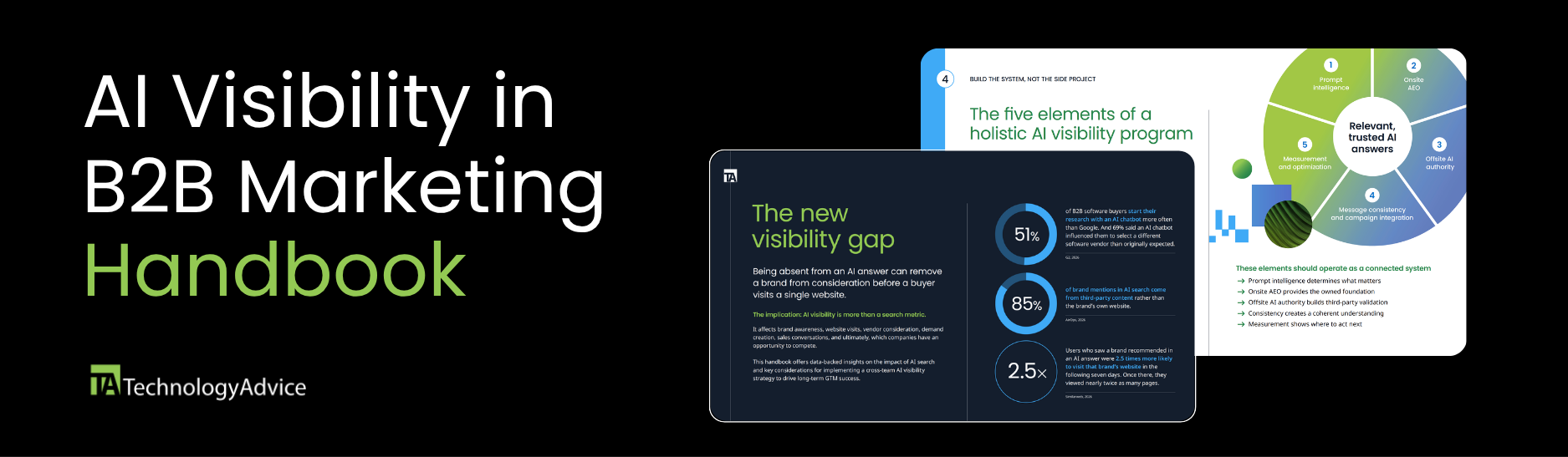
LOOKING TO UNDERSTAND THE BIGGER AI VISIBILITY PICTURE? Explore how AI is reshaping product discovery, evaluation, and decision-making in the AI Visibility Handbook for B2B Marketing Teams.
What B2B marketers should do now
If buyers use AI across the journey, your AI visibility strategy has to cover the journey too.
1. Map the questions behind each decision stage
Start by identifying the questions buyers are likely to ask as they move from discovery to evaluation and validation.
Early-stage prompts may focus on trends, problems, and category education. Middle-stage prompts often request product recommendations. Late-stage prompts may investigate vendors, integrations, ROI, risks, or implementation concerns.
Don’t stop at a generic list of keywords. Account for different industries, company sizes, use cases, regions, technical environments, and buying-group roles. The more complex the sale, the more surface area your strategy needs to cover.
2. Examine the answers buyers receive
Test relevant prompts across the AI platforms your audience uses. Look beyond whether your brand appears and assess:
- Which vendors are recommended and in what order
- How your company and products are described
- Whether the answer reflects your intended positioning
- Which strengths, limitations, and use cases are emphasized
- Whether important information is inaccurate or outdated
- Which competitors appear more consistently
This can reveal gaps buyers may encounter before reaching your website or sales team.
3. Strengthen owned content and AEO
Your website remains an essential source of product facts, category expertise, use cases, implementation guidance, and proof. Content should address real buyer questions clearly enough for people and AI systems to understand.
That may require filling topic gaps, clarifying product language, strengthening evidence, and organizing information around real buyer questions. Answer engine optimization can make those signals clearer.
But owned content is only one part of the information environment AI systems rely on.
4. Build third-party validation and off-site authority
AI answers draw from credible sources across the web. In fact, the latest research from AirOps suggests that 85% of brand mentions in AI answers are sourced from independent third-party content rather than the brand’s own website. Third-party editorial media, expert research, product reviews, vendor comparisons, practitioner commentary, and communities all play a major role in validating products and reinforcing how brands are understood.
The goal for modern marketing teams should be to establish consistent, credible information around the categories, problems, use cases, and outcomes your brand wants to own. Owned content and AEO articulate your story. Trusted third parties validate and reinforce it.
The new B2B shortlist may begin inside an answer
AI search is changing where buyers form their first impressions and how quickly those impressions can become a shortlist. TechnologyAdvice’s research indicates that this activity extends beyond broad discovery: more than 36% of the analyzed B2B technology queries were connected to product research, vendor comparison, and solution evaluation.
For marketers, the AI search objective is broader than earning another click. It’s to be:
- Visible during discovery
- Recommended during evaluation
- Accurately represented during validation
- Trusted when the buying group makes its decision
That requires a coordinated approach to AI Visibility across buyer-question research, owned content, AEO, and credible third-party validation.
Because when AI helps a buyer decide what matters, the brands included in the answer will have an advantage long before that buyer reaches any vendor website.
Build an AI visibility strategy for the entire journey
Understanding how AI influences the B2B buying journey is one thing. Building a strategy around that influence is another.
The AI Visibility Handbook for B2B Marketing Teams explores how AI is changing discovery, evaluation, and decision-making, and what it means for your digital, demand generation, brand, content, and product marketing teams. Use it to start mapping priority prompts, assessing how your brand appears, and connecting owned content and AEO with credible third-party validation.
Get the AI Visibility Handbook →
Here’s to making your brand impossible to overlook.