If it feels like the B2B marketing landscape has evolved more in the past 18 months than in the preceding five years, you’re not alone. Buyer behavior changes are accelerating. Digital channels are becoming more fragmented and competitive. And AI is becoming a force multiplier for those teams that truly embrace it.
The good news? Rapid change brings opportunity.
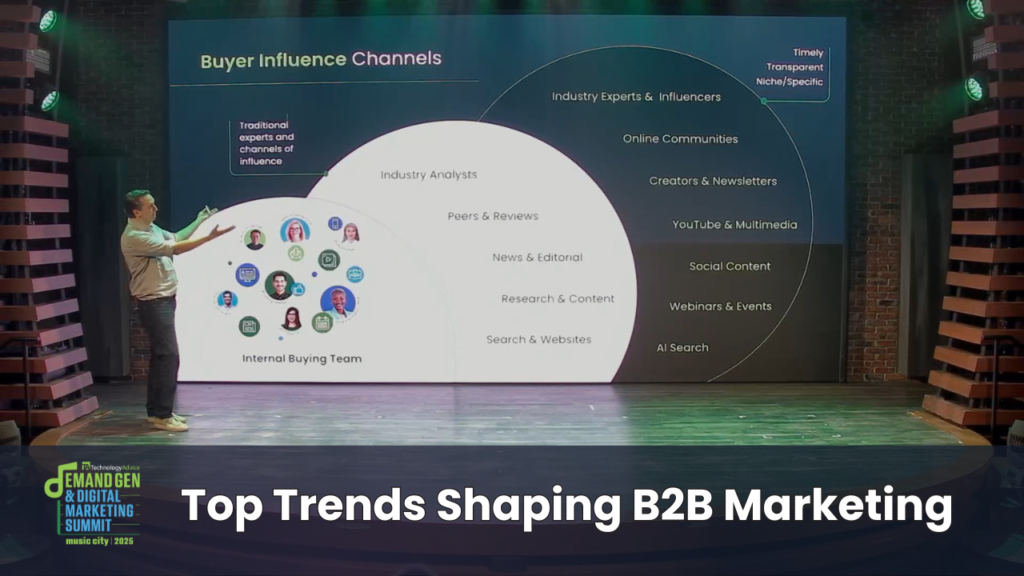
At this year’s Music City Demand Gen Summit in Nashville, we unpacked three emerging trends that are reshaping how modern marketers connect with today’s B2B tech buyers. These are more than surface-level observations – each is backed by fresh research, channel insights, and real campaign results across the TechnologyAdvice network.
Here’s what you need to know, and what to start acting on, as you plan your 2026 demand‑gen strategy.
Trend #1: Preference Marketing Takes Center Stage
Here’s a stat that should make every B2B marketer take notice:
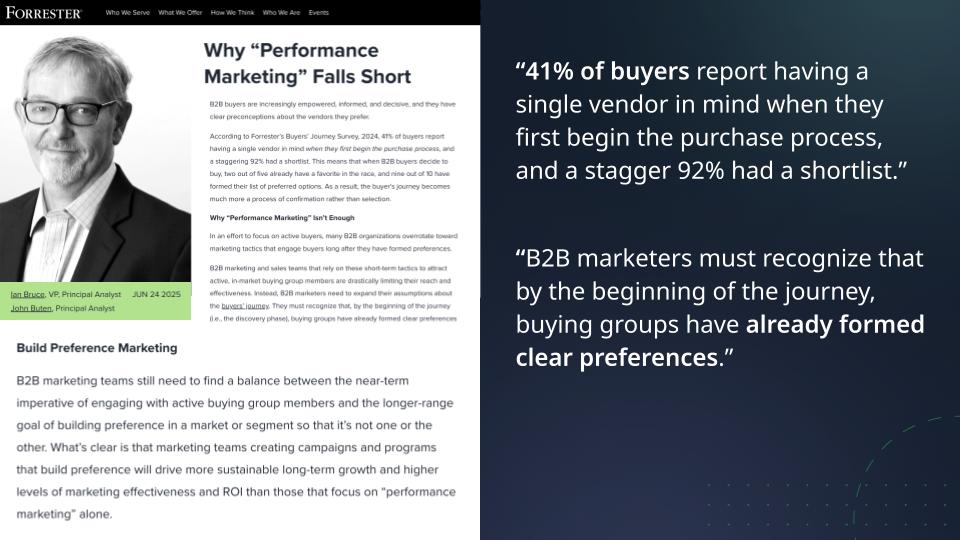
According to Forrester’s most recent Buyers’ Journey Survey, “41% of B2B buyers report having a single vendor in mind when they first begin the purchase process, and … 92% had a shortlist.” (Forrester)
In other words: by the time a potential buyer comes to your website or fills out your form, the game is mostly over. And this trend is only accelerating thanks to rapid advancements in AI search and recommendations, as well as the growing impact of creators and influencers on younger decision makers (more on that later).
What is Preference Marketing?
Preference Marketing is the intentional act of shaping buyer perception before traditional intent signals appear. This isn’t just awareness, it’s about becoming the brand that buyers prefer, so when they start serious evaluation, you’re already there.
Think of it this way: the difference between being discovered and being chosen.
Why this matters
If 41% already have a vendor in mind at the start of the process, and 92% have a shortlist already built, your window to influence has moved earlier. (Forrester)
Forrester argues that “B2B marketers need to expand their assumptions about the buyers’ journey. They must recognize that … by the beginning of the journey … buying groups have already formed clear preferences and informal shortlists.” (Forrester) This means traditional performance‑marketing tactics (ads, gated content, bottom‑of‑funnel offers) are missing the moment of influence. The brand‑preference phase is far more important now – and when done well, it drives much more efficient lead generation and performance marketing.
What leading marketers are doing
Marketers embracing this trend are shifting spend from strictly performance campaigns into brand‑building programs that influence early on in the buying journey. They’re leveraging high‑authority content partnerships, trusted media platforms, creator‑led content, social proof, and other tactics to create brand awareness, authority, and ultimately preference.
They’re producing strategic thought leadership content not just to generate leads but to foster brand affinity and authority. Beyond blogs and white papers, these marketers are investing in expert panels, thought‑leadership video series, targeted community engagements, and high‑visibility brand placements.
They’re also running always‑on programming to influence buying teams months before they even declare intent. It’s about staying top‑of‑mind when the shortlist is being built.
And finally, they’re measuring new metrics such as preference scores, brand sentiment, and share of voice in target accounts to better understand how their programs are resonating with potential buyers.
Takeaway: Winning in 2026 means marketing teams must build brand preference before intent has surfaced. If buyers don’t know you, or don’t like what they know, your lead generation efforts may be wasted.
Trend #2: Mastering the Buyer Influence Map
Your buyers aren’t just reading blogs and attending webinars anymore. They’re scanning Reddit threads, watching YouTube deep‑dives, subscribing to niche newsletters, following LinkedIn micro‑experts, and checking third‑party review platforms.
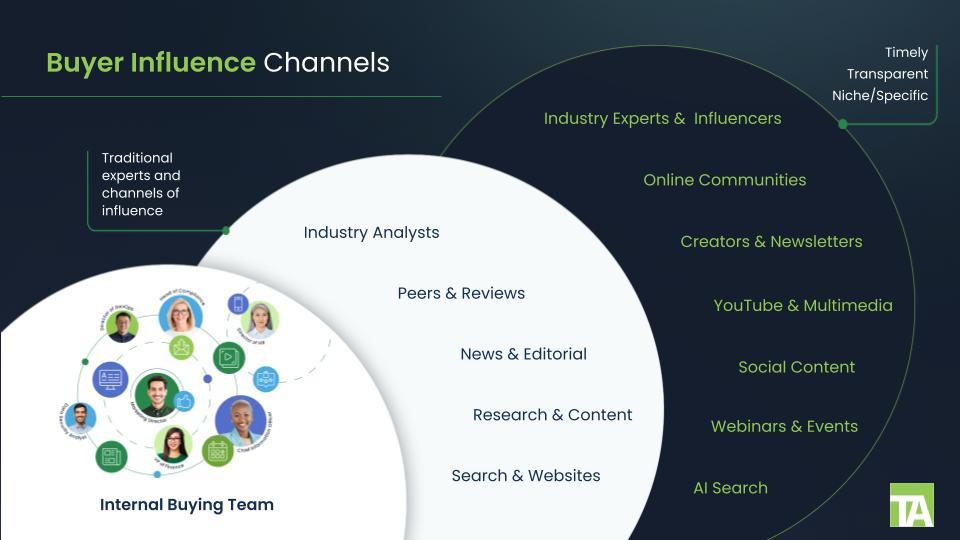
This behavior shift has given rise to what we’re calling the Buyer Influence Channel Map: a modern representation of how buyers research and learn before and during the evaluation process, identifying what (and who) is most likely to be influencing them throughout their buying journey.
What the data shows
Forrester’s latest research suggests that “Millennials and Gen Z now make up over two‑thirds of buyers involved in large and complex transactions.” (Forrester) It also predicts that “Half of younger buyers will include 10 or more external influencers in their purchase.” (Forrester)
They go on to note that “Social media platforms … already rank among the top three preferred interaction types among young buyers” and they are commonly influenced by online community members, 3rd party review sites, conference attendees, industry creators and experts, role-specific newsletters, and more. (Forrester)
In today’s world of marketing, it’s more than just showing up on the right channels. We need to reach our potential buyers through an increasingly complex web of internal and external influence, with a focus on those sources of influence that hold the greatest credibility and trust.
What the “Map” looks like
Think of it visually: rather than a straight line funnel, you have multi‑directional flows:
- Awareness / Browsing phase: YouTube explainers, Reddit threads, industry media sites, LinkedIn posts, newsletters, peer‑to‑peer groups.
- Interest / Research phase: Review sites, community discussions, social media comments, vendor‑agnostic podcasts, timely and credible industry research.
- Consideration / Validation phase: Expert panels, analyst/expert content, customer stories, product‑comparison portals.
- Decision phase: Vendor site, demo, RFP (but by now the heavy influence phase has been done)
You can also think about the new Buyer Influence Map through the lens of ‘traditional’ versus ‘new’ channels of influence. The visual below captures how the influence map has evolved in recent years, giving you an initial framework for how to think about the channels, brands, and personalities that are influencing your target buyer:
What this means for marketers
Your content and brand must be channel‑native, reaching your target audience via their preferred sources of trusted information. A webinar on your site may not reach the 30‑something buyer browsing YouTube and reading a niche newsletter while commuting.
You need to identify the invisible influencers – industry community leaders, content creators, newsletter writers, researchers and reviewers – who are not “official” but shape opinion. Influencer marketing in B2B is no longer just hiring a “tech influencer.” It’s understanding the network of trust your buyer relies on and showing up credibly across those nodes.
In 2026, an omnichannel strategy isn’t optional, it’s table stakes. But it’s not just “run everywhere.” It’s “run where your buyer already is, in their language, format, and context.”
Actionable ideas
Consider the following actions to put these ideas into practice within your own team:
- Build your own Buyer Influence Channel Map: List your target personas and ask: What media outlets and newsletters do they trust? Which platforms do they use? Who influences them? What formats do they prefer? Then map your content and distribution accordingly.
- Partner with high‑authority communities and influencers: Rather than only driving traffic to your site, go to where the buyer is. Sponsor a newsletter, guest on a niche podcast, partner with an industry creator for a video series.
- Diversify your formats: Short‑form videos, social stories, Reddit AMAs (ask‑me‑anything), LinkedIn newsletters, peer panels – not just long whitepapers.
Trend #3: AI Agents as Part of Lead Gen Workflows
“AI-powered marketing” is no longer just a buzzword. And in 2026, the real change is that autonomous AI agents are being embedded into lead‑gen workflows, allowing teams to target more precisely, personalize more deeply, and scale more rapidly than ever before.
What’s changing
AI isn’t just writing blog posts or ad copy – it’s becoming operational. It’s being used to score leads based on multi‑signal intent (first‑party + third‑party + behavioral), it’s generating hyper‑personalized email outreach and content offers in real time, and it’s dynamically routing leads to the right nurture tracks and predicting the next‑best offer for each persona.
At TechnologyAdvice, we’ve embedded AI agents within our Traction platform (which powers the lead gen programs we run for our clients) to identify, engage, and convert high‑intent buyers more efficiently. It’s being used to identify potential buying committee members at high-intent accounts, write and send hyper personalized emails, and aggregate lead intelligence data from a myriad of sources. The outcome: more lead engagement, improved conversion rates, and smarter media spend.
How this unlocks new potential
Autonomous AI Agents will continue to unlock new value and potential within various areas of B2B marketing, including:
- Faster time to pipeline: AI agents reduce the lag time between a buyer’s signal and the right action. No more waiting for manual scoring, human alignment or siloed teams.
- Better buyer experience: Personalized messaging at every touchpoint, driven by real‑time data and intelligent routing. Your buyer sees content relevant to them, not generic marketing.
- More efficient spend: Resources go only to accounts showing real signals, with AI helping to detect those signals earlier and more reliably.
- Scale without sacrificing relevance: Teams can engage with more accounts and personas, at scale, without losing the “human” feel that B2B buyers also expect.
Practical considerations
While the promise of AI is significant, there remains a number of challenges and practical considerations for widespread adoption and value realization in 2026, including:
- Data hygiene and signal layering matter: The best AI workflows rely on clean first‑party data plus trusted third‑party intent sources. Without a strong data foundation, the AI agent will under‑deliver.
- Governance & oversight still required: Autonomous doesn’t mean unmanaged. Teams need to define logic, thresholds, escalation rules, and ensure agents operate within brand voice and compliance guidelines.
- Align teams around the workflow: Marketing, sales, operations, analytics must agree on what “signal” means, how routing happens, and how buyer personas and content offers are structured.
- Measure differently: Beyond MQLs, you’ll need to track speed to lead, conversion by persona, next‑best‑action lift, pipeline growth driven by AI‑enabled accounts, and even cost per influenced‑opportunity.
- Start small, then scale: Choose a pilot segment or geography, embed the agent workflow, measure impact, refine logic, then expand.
Pro Tip: If you’re still treating AI as just a content tool (e.g., “AI writes blog posts”), you’re missing the real opportunity. Evaluate platforms and service providers that embed AI agents into your targeting, routing and personalization workflows, not just creative generation.
Wrapping It Up: 2026 Will Belong to Marketers Who Adapt Now
These three trends aren’t passing fads. They reflect structural shifts in how buyers behave and how marketing teams must operate to connect, influence, and convert effectively.
If there’s one theme that ties all three together, it’s this:
B2B marketers in 2026 must balance brand‑building with pipeline precision.
That means investing in:
- Content that builds trust and preference early.
- Channels that influence buyers before they raise their hand.
- AI‑powered workflows that maximize every signal, click and conversion.
The days of relying solely on MQLs and bottom‑of‑funnel hand‑raisers are coming to an end. It’s time to build demand by becoming the brand your buyers already prefer, and by operating with the agility, intelligence, and scale that AI enables.
Want to go deeper?
Watch the full presentation from the Music City Demand Gen Summit where we dive deeper into these top trends with real examples of how TechnologyAdvice is embracing them on behalf of our clients: